Roulette is the most mathematically transparent game in any casino. Unlike slots, where the underlying probabilities are hidden inside proprietary software, or poker, where skill and psychology muddy the waters, roulette lays its maths bare.
There are 37 pockets on a European wheel, each equally likely, and every payout is a simple matter of arithmetic. And yet roulette remains the game most surrounded by myths, systems, and outright misconceptions. Understanding the actual numbers is the difference between playing with clear eyes and chasing patterns that don’t exist.
Where the house edge actually comes from
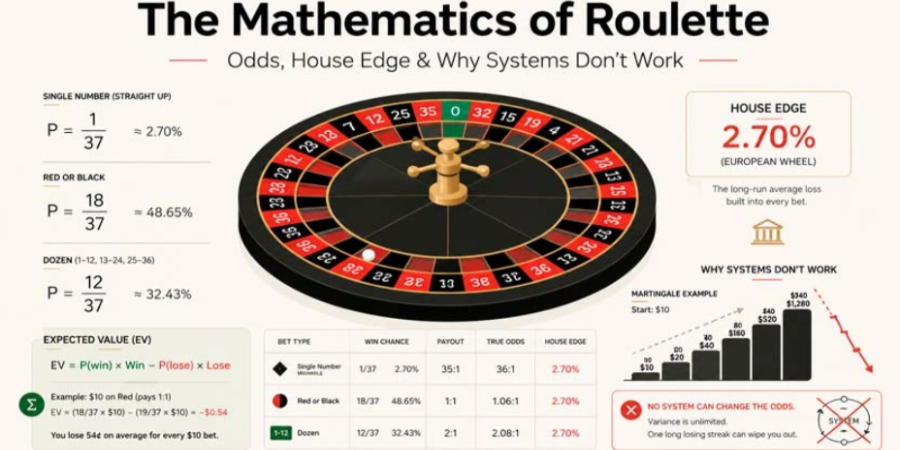
The entire economics of roulette rest on a single design decision: the zero. On a European wheel there are 37 pockets — numbers 1 to 36 plus a single zero. If you bet on a single number, your true probability of winning is 1 in 37, or roughly 2.7%. But the casino pays you 35 to 1, not 36 to 1. That gap between true odds and payout odds is the house edge, and it works out to exactly 2.7% on every bet you place.
The American wheel adds a double zero, bringing the total to 38 pockets. The payout stays at 35 to 1, which doubles the house edge to 5.26%. This is why experienced players always seek out European or French tables — the game looks identical, but the American version takes nearly twice as much from your bankroll over time. French roulette, with its “la partage” rule returning half your even-money stake when zero hits, drops the edge on those bets to just 1.35%, making it the most player-friendly variant available.
Every bet, the same edge
Here’s what surprises most players: on a European wheel, almost every bet carries an identical house edge of 2.7%. Straight up on a single number, split bets, corners, columns, dozens, red or black, odd or even — the maths works out the same. What changes is variance, not expectation. A single-number bet wins 2.7% of the time and pays 35 to 1. An even-money bet wins 48.6% of the time and pays 1 to 1. Both return the same theoretical percentage over the long run; they simply distribute your outcomes differently.
This distinction matters when planning a session. A player wanting extended play on a modest bankroll should stick to outside bets, where wins come frequently and swings are gentle. A player chasing a large payout accepts that most spins will lose. Neither approach beats the house, but they produce very different experiences.
Working out the exact figures for each bet type — probability, payout, and the resulting expected value — is straightforward with a dedicated tool. RouletteCalc lets players calculate the odds, house edge and expected return for any roulette bet across European, American and French variants, showing precisely how much each wager type gives away to the house and how the numbers shift between wheel layouts.
Seeing those percentages side by side makes the cost of choosing an American table over a European one immediately obvious.
Why betting systems always fail
The Martingale system — doubling your stake after every loss — is the most persistent myth in gambling. The logic seems airtight: eventually you must win, and that win recovers everything plus one unit of profit. The flaw is brutal. A run of ten consecutive losses on an even-money bet, which happens more often than intuition suggests, requires a stake of 1,024 units to continue. Table limits and finite bankrolls guarantee that the sequence breaks before the win arrives.
The deeper problem is that no staking pattern can alter the house edge. Each spin is independent — the wheel has no memory of what came before. The Royal Statistical Society and mathematicians generally have made this point for decades: rearranging the size of negative-expectation bets cannot produce a positive expectation. The Martingale, the Fibonacci, the d’Alembert, the Labouchère — all of them simply redistribute when and how you lose.
The gambler’s fallacy in action
Closely related is the belief that outcomes are “due”. Red has come up eight times in a row, so black must be more likely now. It isn’t. The probability of black on the next spin remains 48.6%, exactly as it was before. The most famous demonstration came at the Monte Carlo Casino in 1913, when black hit 26 consecutive times and players lost fortunes betting ever-larger sums on red, convinced the streak had to end.
Understanding independence isn’t just an academic point — it protects your bankroll. Players who believe in streaks escalate their stakes at precisely the wrong moments, turning a manageable session into a serious loss.
Playing responsibly with the numbers in view
The honest conclusion from the maths is that roulette cannot be beaten over the long run. What the numbers do offer is clarity: choose European or French over American, understand that all bets carry the same expectation, and treat the house edge as the price of entertainment rather than an obstacle to be outsmarted. The UK Gambling Commission emphasises that players should set limits before they start and treat gambling as a leisure activity rather than an income source — advice that follows directly from the mathematics.
Roulette rewards those who understand it, not with profit, but with realistic expectations. Know the odds, pick the right wheel, size your bets to your bankroll, and accept the edge for what it is. That’s not a strategy for winning — it’s a strategy for enjoying the game without illusions.