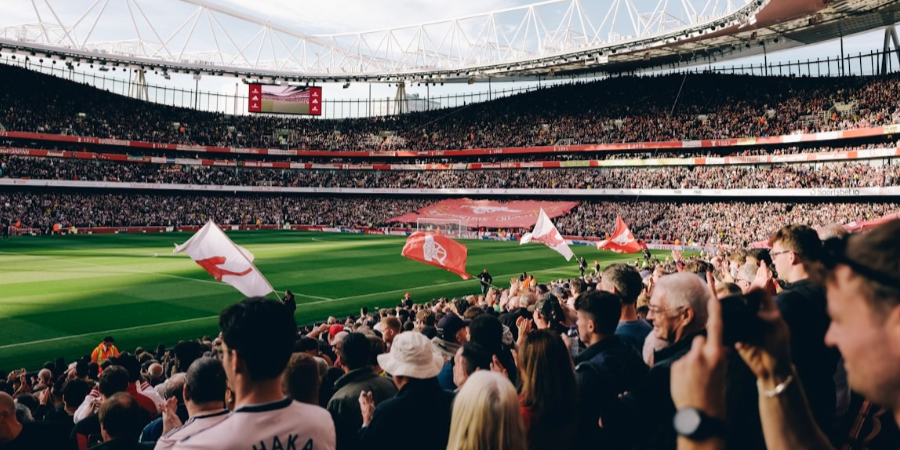
The board rises beside the touchline and shows eight additional minutes. A team that expected to defend one final attack must now survive a period almost as long as extra time in a boxing round. Substitutes press against tiring defenders, set-piece specialists move forward and the goalkeeper becomes part of every restart.
Added time was once treated as the loose end of a match. More accurate timekeeping has changed that calculation. Premier League matches now regularly continue beyond 100 minutes, giving coaches enough time to use a distinct tactical plan after the regulation 90 have passed.
The Clock Records More Than Injuries
Additional time is not created only by injured players receiving treatment. Officials record delays produced by substitutions, disciplinary action, goal celebrations, VAR checks and other interruptions. Time lost during the announced minimum can also extend the match further.
A comparable distinction exists in online casino play. Independent information sources, including australiacasinopokies.com featuring online casinos in Australia, explain games in which a stake is accepted before the selected round begins. If the visible session is interrupted, the recorded round can still reach its result, be settled and update the account balance without treating the interruption as a new wager.
Football cannot recover every second during which the ball is out of play, because throw-ins and ordinary restarts are part of the match. The recent approach instead targets identifiable delays more accurately. That has made the number on the fourth official’s board larger and less predictable.
The Change Can Be Measured
Premier League officials adopted stronger timekeeping guidance for the 2023/24 season. The official Premier League analysis of added time reported that the ball was in play for an extra three minutes and 45 seconds per match during the first half of that campaign compared with 2022/23.
The difference becomes clearer across several seasons:
| Season | Average match duration | Average ball-in-play time | 90+ minute goals |
| 2022/23 | 98:27 | 54:52 | 84 |
| 2023/24 | 101:42 | 58:37 | 112 |
| 2024/25 | — | 56:58 | 94 |
The 2023/24 total of 112 goals after the 90th minute set a Premier League record. Added time then became shorter in 2024/25, declining by an average of one minute and 51 seconds across both halves, but the league still produced 94 such goals. That was the second-highest seasonal total recorded at the time.
The trend continued in 2025/26. After Matchweek 24, matches were lasting 100 minutes and 20 seconds on average. There had already been 76 goals in or beyond the 90th minute, accounting for 11.4 per cent of all league goals at that stage.
Five Substitutions Changed the Final Contest
Longer matches do not simply give the original 22 players more football. Each team can make five substitutions, usually across three opportunities excluding half-time. A manager can therefore reserve fast attackers, an aerial defender or a set-piece specialist for the closing period.
Several changes become visible once the match enters added time:
- fresh forwards press defenders who have already played 90 minutes;
- full-backs with cramp face substitutes selected for acceleration;
- central defenders join attacks when an equaliser is required;
- a leading team adds height to defend corners and free-kicks;
- goalkeepers advance for late set pieces when defeat and a draw carry sharply different value.
This produces an unusual contest. The players deciding the match may not be those who established its earlier pattern. A substitute can enter in the 88th minute and still receive ten or more minutes to influence the score.
Harvey Barnes provided an extreme example in Newcastle United’s 4–3 victory over Leeds United in January 2026. Newcastle entered added time behind, Bruno Guimarães equalised, and Barnes scored the winner at 101 minutes and 48 seconds. It became the latest winning goal in Premier League history.
Protecting a Lead Requires More Than Retreating
A side leading by one goal has several possible approaches. Dropping every player near the penalty area protects the centre but invites crosses, corners and second balls. Keeping possession moves the immediate danger away from goal, although losing it with players spread across the pitch can create a counterattack.
The most reliable late-game plans usually combine several actions:
- retaining the ball near the corner rather than forcing a cross;
- using safe passes that make the opposition continue pressing;
- committing tactical fouls before a counter reaches the defensive third;
- avoiding unnecessary challenges near the penalty area;
- preparing positions for the second ball before taking a goal kick;
- deciding in advance whether the goalkeeper should claim or punch a cross.
Set pieces have gained particular importance. Early in the 2025/26 season, the Premier League recorded a goal from a stoppage-time set piece once every ten matches, compared with once every 15 games in 2024/25. Tired marking and the presence of additional attackers make each late delivery more dangerous.
The Score Determines How Time Feels
Eight added minutes mean different things at 0–0, 1–0 and 3–0. A level match can leave both teams deciding whether one point is worth protecting. A narrow leader wants controlled possession, while the trailing side accepts greater defensive risk.
Tournament context adds another layer. A club fighting relegation may send its goalkeeper forward for a corner because a draw has immediate value. In a two-legged knockout tie, the same score can encourage patience if another match remains. The clock does not dictate the strategy alone; it amplifies the importance of the existing score.
There is also a psychological effect. A team that expected the whistle after four minutes can become anxious when play reaches 90+8. Opponents sense that discomfort, increase the number of direct passes and contest every restart as a possible final opportunity.