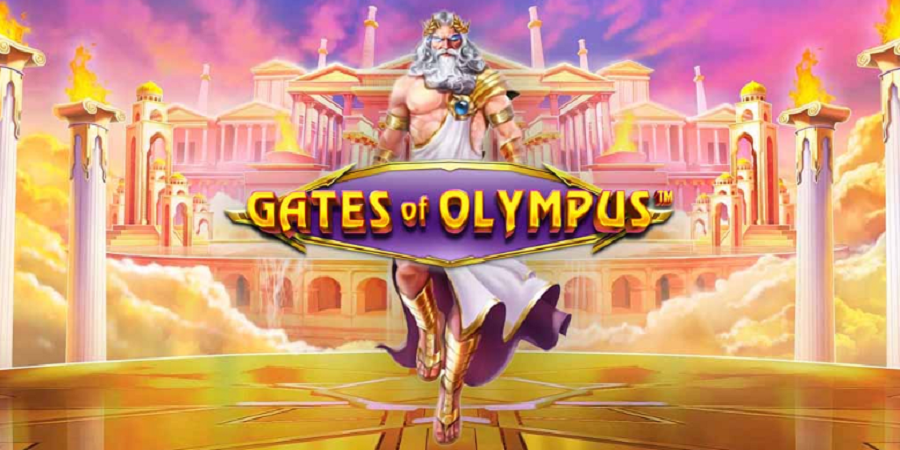
Most slot games ask you to line up matching symbols across a set of fixed paylines. Gates of Olympus does not work that way, and this is the first thing worth understanding before you open the game for the first time. There are no paylines here. Instead, there is a six-column, five-row grid, and what matters is how many matching symbols land anywhere on that grid at the same time. Get eight or more of the same symbol touching each other somewhere on the board, and the game counts it as a win. That shift away from traditional paylines changes how the whole thing feels to play, and it is what gives the game its particular rhythm.
Released by Pragmatic Play in 2021, Gates of Olympus has stayed near the top of the popularity charts at Jabula Bets and across most online casinos for long enough that it deserves a proper explanation rather than a quick summary.
How does the basic gameplay actually work?
The grid sits in front of a golden Mount Olympus setting, with Zeus visible on the right side of the screen and a stormy sky in the background that reacts when something significant happens. The symbols on the grid are divided into two groups. The lower-value ones are five coloured gems in red, purple, yellow, green and blue. The higher-value ones are four divine objects: a diadem, an hourglass, a ring and a cup. Getting a cluster of eight or more of the higher-value symbols pays considerably more than the same cluster size of gems, which is worth knowing before you start playing.
What happens after a cluster win is the mechanic that defines the whole game. The winning symbols disappear from the grid, the remaining symbols fall downward to fill the gaps, and new symbols drop in from the top to replace what left. The game then checks whether the new arrangement creates another cluster of eight or more anywhere on the board. If it does, that counts as another win, the process repeats, and this can continue as many times as new winning clusters keep appearing. There is no limit to how many times this can happen within a single paid spin. A single bet can therefore produce a chain of five, six, or more wins if the symbols keep lining up. Most spins do not produce chains that long, but when they do, the cumulative payout from one bet can be considerably larger than anything a standard spin-and-stop mechanic could produce.
What are the multiplier orbs and how do they change things?
At any point during a spin, including during the tumble chains, Zeus can throw glowing orbs onto the grid. These orbs carry a multiplier value somewhere between 2x and 500x, and when one lands during a winning tumble, its value is added to a running total for that spin. A detail that matters here: if three orbs land in the same sequence carrying values of, say, 20x, 50x and 100x, those values are added together to give a total multiplier of 170x — they are not multiplied against each other. The distinction is worth being precise about because it changes how you read a spin while it is happening.
In the base game, the accumulated multiplier from a sequence applies to the win from that sequence and then resets when a new paid spin begins. In the free spins round, this changes significantly, and the change is the main reason why the bonus feature is where the largest payouts happen.
How does the free spins round work?
To trigger the free spins round, you need to land four or more Zeus scatter symbols anywhere on the grid during a single spin. Four scatters gives you 15 free spins and a one-time bonus payment of three times your bet. Five scatters gives 15 free spins plus five times your bet. Six scatters gives the same 15 free spins but adds a bonus payment of a hundred times your bet, which is a significant number on its own before the feature even begins.
During the free spins, the multiplier orb mechanic continues working as it does in the base game, but with one critical difference: the accumulated multiplier does not reset between spins. It carries over and continues growing throughout the entire feature. A free spins round where several orbs land across multiple spins can build a cumulative multiplier that turns later wins in the sequence into payouts worth many hundreds of times the original bet. This carry-over mechanic is the reason why the game’s maximum win potential sits at 5,000 times the stake, and why sessions can swing so dramatically depending on how the free spins round behaves.
Landing three or more Zeus scatters during the free spins round adds another five spins to the remaining total, which means the feature can extend well beyond its initial 15 spins if the scatters keep appearing. Since the multiplier never resets, a long extended bonus round with several orb hits tends to be where the game’s most memorable payouts occur.
What is the Ante Bet and is it worth using?
The Ante Bet is an optional feature that increases your stake by 25 percent per spin — a bet of one unit becomes 1.25 units — in exchange for roughly double the natural frequency of Zeus scatter symbols appearing on the grid. The practical effect is that you trigger the free spins feature more often when using the Ante Bet than you do at the standard stake level, because scatters appear more frequently.
Whether this is worth the extra cost depends on what you are trying to do. Over a longer session where reaching the bonus round is the main goal, the increased scatter rate compounds into meaningfully more frequent triggers, which means the extra cost tends to even out over time. For shorter sessions or tighter budgets, it adds up quickly. One thing worth knowing: you cannot use the Ante Bet and the Bonus Buy feature at the same time, so if both are available at your casino, you need to choose one approach before you start.
The Bonus Buy, where it is available, lets you enter the free spins feature directly at a cost of 100 times your current bet. A one-unit bet costs 100 units to buy in. This gives immediate access to the feature without waiting for scatters to land naturally, but it takes a meaningful portion of a session budget in one move, so it works better as a deliberate choice than as a reaction to a slow start.
What does the RTP and volatility actually mean in practice?
The standard RTP for Gates of Olympus is 96.50 percent, which sits slightly above the average for online slots. Some versions of the game run at a lower configured RTP of around 94.52 percent depending on the operator, so it is worth opening the information panel at whichever casino you play at and checking which version is active before you start.
High volatility means the game does not pay out small wins frequently. Many spins produce nothing, and a long run of empty or minimal results between significant wins is completely normal and expected, not a sign that something is wrong. The structure of the game is built around the idea that most of the return comes from a smaller number of larger events, particularly bonus rounds with strong multiplier chains, rather than from steady small wins across regular play.
For players who prefer constant low-level feedback and frequent small returns, the pacing of Gates of Olympus can feel slow and uncomfortable. For players who are comfortable letting a session run through quieter stretches in exchange for the chance of a sharply larger win during a well-stacked bonus round, the game tends to deliver exactly what it promises. The difference between those two experiences comes down mostly to how much of the session budget is set aside before starting and how much patience sits alongside it.