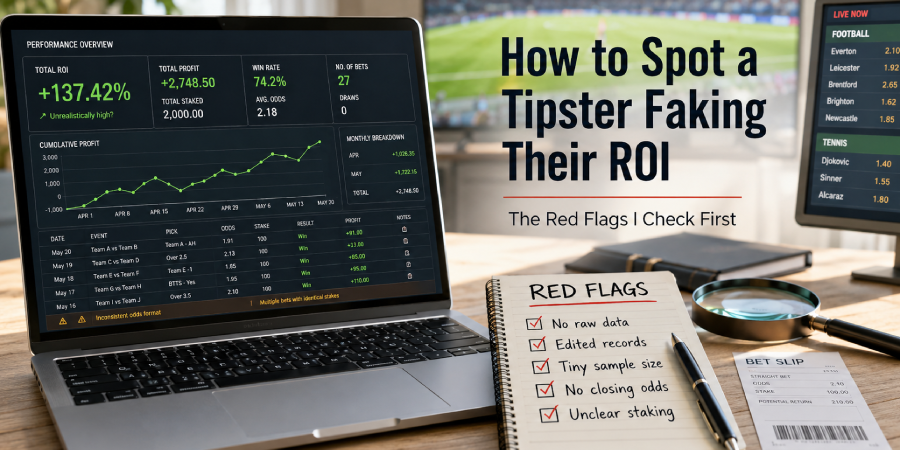
Anyone who has spent time weighing up sports betting services knows the results page is the easiest thing to dress up and the hardest to verify from the outside. A single percentage, however impressive, tells you nothing about the method behind it, and it is in that gap between the headline figure and the operational reality that almost every trick lives. Before I trust any ROI claim, I run through a short list of checks. None of them require advanced skills. What they require is a tipster willing to show the raw data rather than the polished number.
This kind of scrutiny is especially useful for bettors who are still comparing where and how to place their wagers. The same logic applies when looking at the top 10 UK online betting website: a polished ranking or an attractive headline offer is only the starting point, not the proof. What really matters is understanding how those platforms are assessed, what data sits behind the recommendation, and whether the information helps users make a more informed choice rather than simply pushing them toward the loudest brand.
The unmatched bet trick nobody talks about
The most underrated manipulation of all sits on the exchanges, and it catches out anyone who has never actually traded on one. When a tipster tells you to place an order at a given price on a platform like Betfair, that order joins a queue and waits for someone to take the opposite side. If no lay order exists at your requested price, your bet sits as unmatched, in the queue but not yet active. If nobody matches it before the market closes or turns in play, the bet lapses and the money is returned. In plain terms, no capital was ever at risk. A dishonest tipster exploits this asymmetry. When the advised price never got matched but the selection wins anyway, the operation gets logged as an executed winner and folded into the headline ROI. When the unmatched selection loses, it quietly becomes void or vanishes from the record entirely. The result is a retrospective filter that inflates the strike rate without a single euro ever changing hands. So the first thing I check is how a service treats unmatched and partially matched bets, and whether it treats them the same way when the outcome is good as when it is bad.
Advised odds versus what you could actually get
The second check is closing line value, the comparison between the price a tipster advised and the market’s closing price. Good verification records the availability of odds at the time tips were sent out, because a price can crash if a tipster is popular or the market is thin. There is no point following an advisor who quotes a player at 50/1 when you could only ever back it at 25/1 after the value had gone. If the platform does not let you check the exact publication time against the start of the event, that figure deserves suspicion. A tipster who consistently reports better prices than were obtainable, or who updates the archive after the result is known, produces a return no follower could have replicated in real time.
Independent proofing, not a self-managed spreadsheet
A track record kept internally on an editable spreadsheet is a track record that can be rewritten at any moment. The genuine safeguard is third-party proofing. Platforms such as Tipstrr, Smart Betting Club, Betting Gods and Racing-Index record each selection with a timestamp and the odds available at publication, and the honest ones lock the history so it cannot be altered after the fact. Tipstrr, for instance, cross-checks odds by algorithm directly against the market, leaving minimal room for manipulation. Free community platforms work on the same principle: OLBG records every bet at the advised odds at the time of release, and tipsters cannot edit or delete past results. One clarification worth making, because it circulates a lot in Italian and English coverage alike. Timeform is not a proofing service. It is a form and ratings resource, invaluable for research, but it does not independently audit and timestamp the picks of external tipsters. If someone points to Timeform as proof their record has been verified by a neutral party, they are describing something Timeform does not do.
Screenshots prove nothing
A cropped image of a winning bet slip is worth exactly nothing as evidence of overall performance. It can be edited, or simply cherry-picked from among dozens of losing bets that were never shown. These screenshots can be faked, and even when real they are usually a snapshot of a good week or month that is not representative of long-term results. The real test of transparency is a complete, downloadable ledger with the date, selection, odds, stake and outcome of every single operation, losers included, not a highlight reel of favourable moments.
Staking, timeframe and the disappearing losing runs
The staking plan is another pressure point. A ROI calculated on a variable or percentage stake that rises after wins and shrinks after losses can make a return look far smoother than a fixed stake would, or can hide a losing streak being chased with escalating bets. Without a staking plan declared up front and applied consistently, the published figure is a number built backwards. Then there is the window. A ROI drawn only from the last thirty or sixty days, with no access to the full history or the drawdowns, shows you the most flattering slice of a far bumpier path. The most cynical version is serial rebranding, where a service quietly closes and reopens under a new name every time the run turns sour, so only the survivors stay visible. The classic mechanic is running several accounts making opposite predictions, then deleting the losing ones and continuing from the accounts that, purely by chance, picked winners.
The gimmes: voids, freebets and impossible win rates
Finally, I look at how everything that is not a clean win or loss gets handled: voided events, non-runners, refunded markets, and bonuses or freebets folded into the return. If those items are always counted in a way that flatters the bottom line, the headline number loses its meaning. And treat any promise of a strike rate above ninety percent, or guaranteed profit, as a warning sign in itself. The industry average ROI sits between three and five percent, anything consistently above seven percent points to genuine skill, and claims above twenty-five percent without real proofing are rarely sustainable. It is also worth separating win rate from ROI: value bettors often run strike rates of thirty to forty-five percent at bigger prices, while favourites specialists might hit sixty to seventy-five percent, so a high win rate alone tells you very little about profit.
None of these checks is difficult. They simply ask the tipster to show the workings behind the number rather than the number alone. If a results page cannot survive that request, the percentage on it was never really yours to trust. Which of these red flags do you check first before following a tipster, and have any of them ever saved you from a bad subscription?